Zero Wait-Time Stimulation, DnB Audio & Hand-Drawn Art
I made Axiom Swerve with a friend using our own custom-engineered game engine, UBQR. From the beginning, we wanted to build a highly stylised, high-stimulation experience with zero wait time—where every moment feels rewarding and keeps the player engaged not just with objectives, but with the visual and audio feedback itself.
Drawing heavily from cyberpunk aesthetics and kinetic bullet-hells, the gameplay revolves around powerups that trigger dynamic screen-space shader effects alongside punchy drum-and-bass sound effects and layered music playlists tied to every action you take. While I directed the visual aesthetic and built the rendering and engine systems, my friend hand-drew the game’s artwork and title logo from scratch.
Beyond being a complete arcade game with gamepad support, spatial 3D audio, and persistent scoreboards, Axiom Swerve also served as a real-world usability test for UBQR. Using the engine’s GameWare workflow and object pooling recipes, iteration moved quickly: within two hours of starting from an empty scene, armed enemies were tracking and firing projectiles at the player; within four hours, multi-enemy wave spawners with pooled death-explosion smoke particles and vehicle afterimage trails were running live.
Dialing In Arcade Grip, Weight Transfer & Wheel Sync
Because vehicular control is the core of Axiom Swerve, we iterated extensively on Jolt’s VehicleConstraint and collider setup. After prototyping basic box and convex-hull chassis shapes across ramps, uneven terrain, and multi-mesh racetrack geometry, we settled on an OffsetCenterOfMass shape to artificially lower the car’s center of gravity—preventing rollovers during sharp high-speed evasions while preserving responsive drift physics.
Each wheel is authored as a child GameWare whose mesh bounding box automatically configures raycast suspension travel, tire width, and steering geometry—keeping visual wheel spin and suspension compression tightly locked to the underlying simulation.
Stylised Smoke & Energy Projectiles Over a PBR World
Our core visual goal for Axiom Swerve was to pair grounded, physically based vehicles and environments (shaded with a Cook-Torrance BRDF, Lambertian diffuse, and orthographic directional shadows) with bold non-photorealistic (NPR) gameplay effects inspired by Need for Speed Unbound and NieR:Automata. Any pooled entity can opt into these stylised pipelines with a single style flag on its model component:
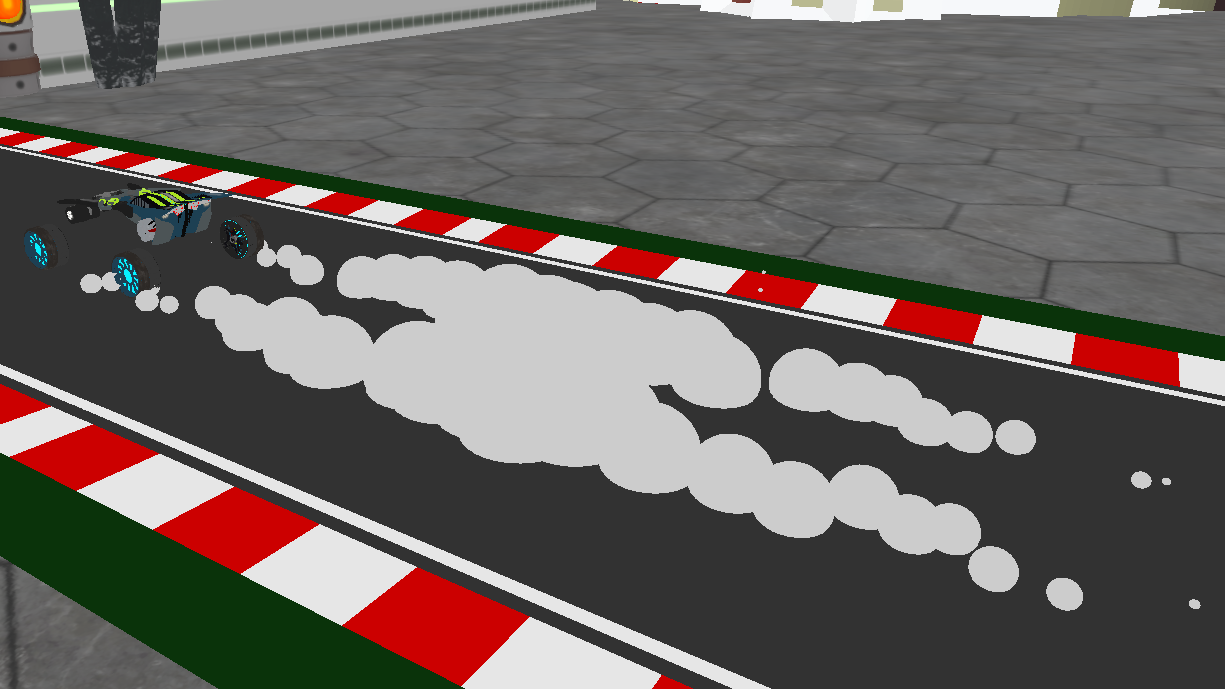
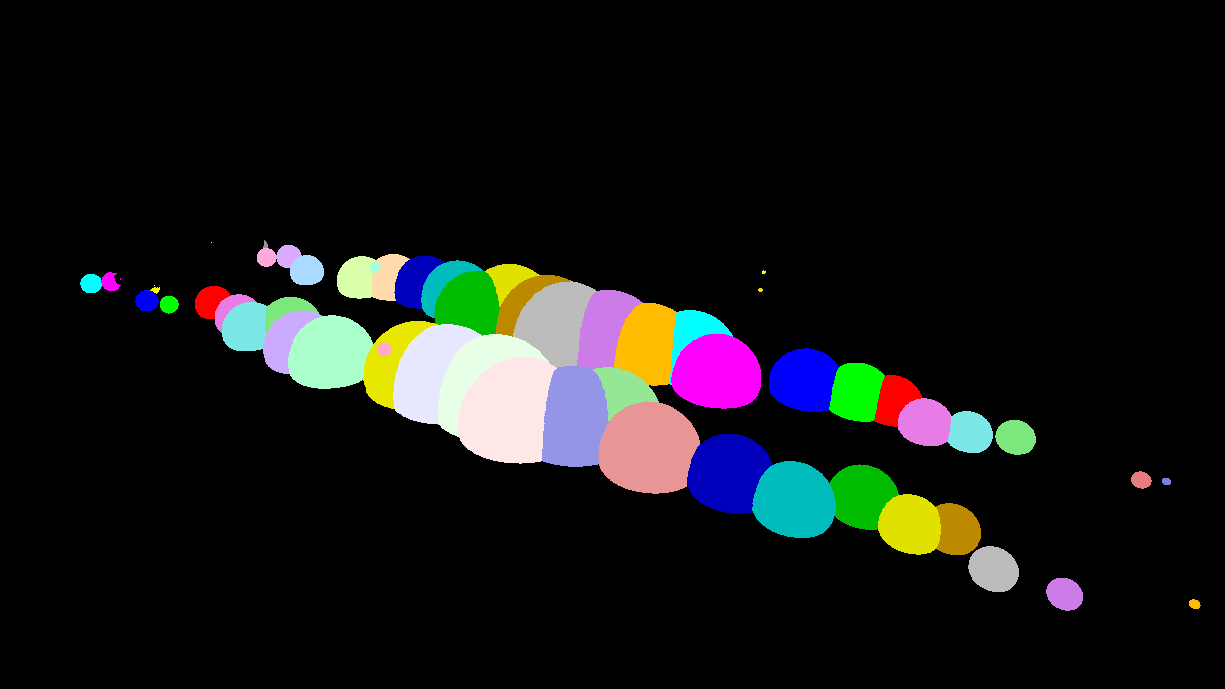
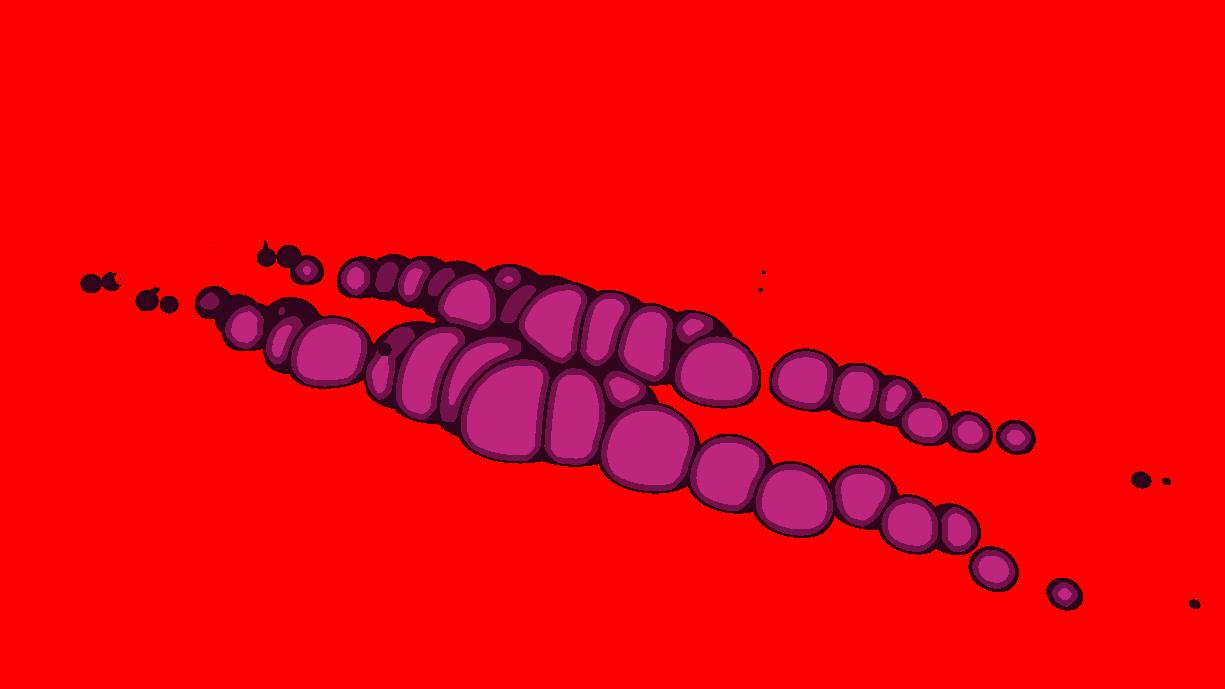
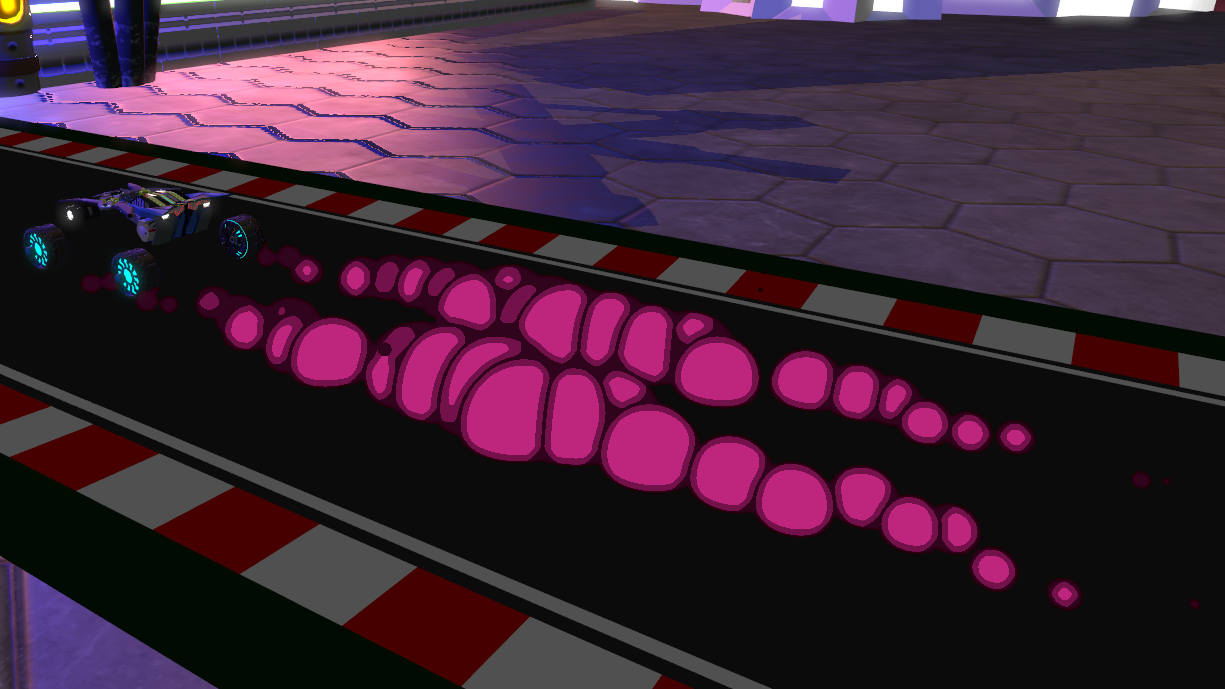
- Pooled Unit-Sphere Smoke & Destruction Plumes (Fig. 1a–1d): Under the hood, tyre smoke and enemy explosion clouds are spawned as pooled unit spheres of varying radii (Fig. 1a). In the first pass, a masking shader assigns each active sphere a unique ID color via push constants while discarding all other scene geometry (Fig. 1b). A second pass applies two 2D Gaussian kernels—one to blur the cluster silhouette and another to detect color boundaries between adjacent spheres—before quantizing the colors into comic-style toon bands (Fig. 1c). By clearing this attachment to pure red
(1, 0, 0)instead of black, dark ink outlines stay cleanly distinguishable from empty background pixels during the final composite over the PBR scene (Fig. 1d). - NieR-Inspired Energy Projectiles: Enemy bullets share the same multi-pass masking architecture but swap the toon shader for a custom 5-texel edge-evaluating kernel driven by animated 2D procedural noise—making incoming bullet-hell patterns pop with high-contrast silhouettes against dark track surfaces.
In-Engine Vulkan Timestamp Profiling at 100+ FPS
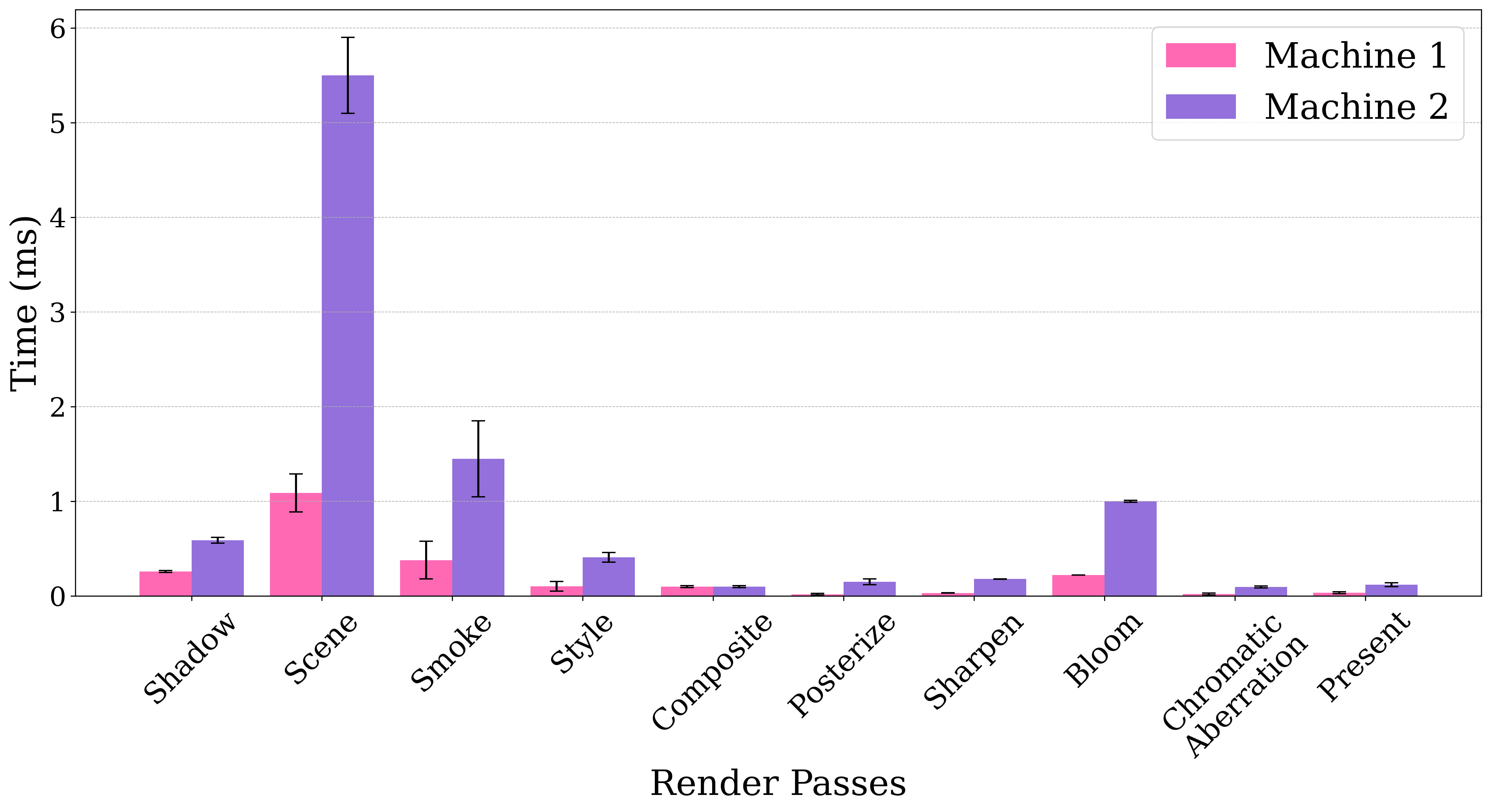
To measure real-time rendering costs per pass, I built an integrated GPU profiler directly into the engine using Vulkan query pools and vkCmdWriteTimestamp, visualizing live pass timings inside the Dear ImGui debug HUD. We benchmarked Axiom Swerve across two distinct hardware tiers:
As shown in Fig. 2, per-pass GPU timings averaged across Level 1 remain low across the pipeline. The scene pass fluctuates with forward over-shading whenever track geometry overlaps in the view frustum, while the smoke & style passes scale dynamically with active projectiles and explosion particles (varying by ~0.1–0.2 ms for smoke and ~0.02 ms for bullets).
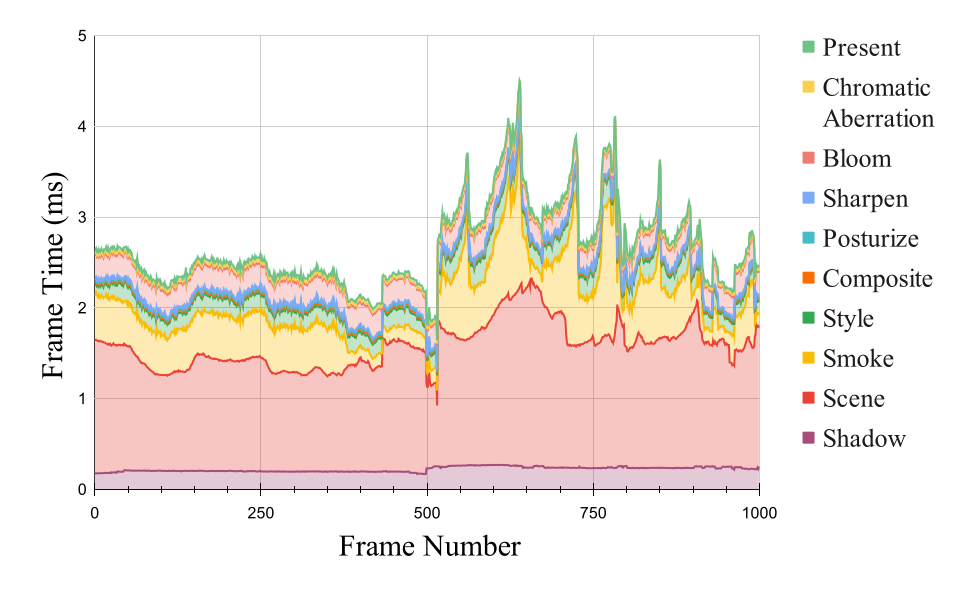
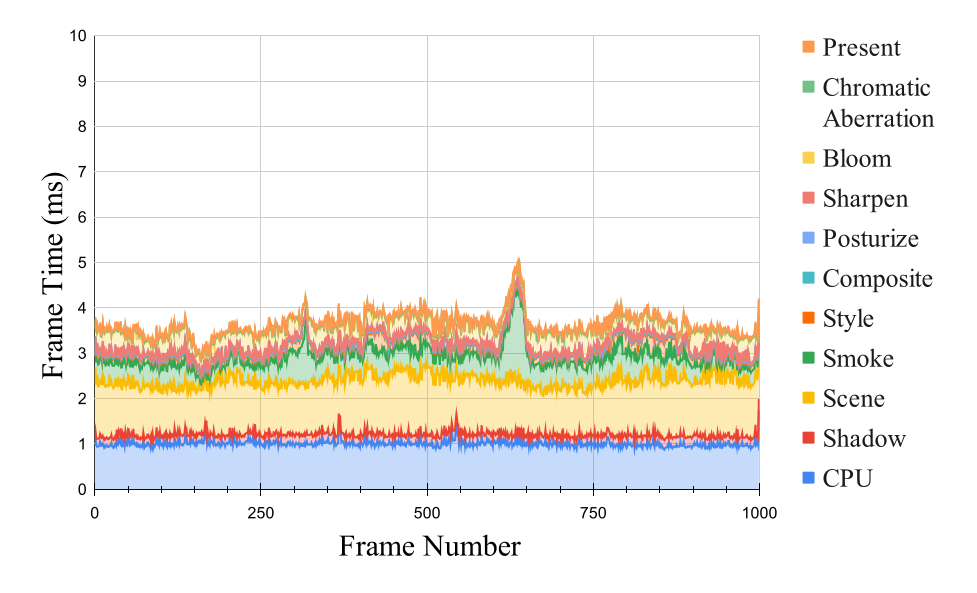
To push the engine to its limits, we captured 1,000 consecutive frames transitioning from standard gameplay (frames 0–500) into an extreme stress-test scenario (frames 500–1,000) spawning 1,500 pooled bullets, 120 enemies, 60 vehicle smoke particles, 40 enemy death particles, and 10 pooled vehicle models for a multi-mesh afterimage trail (~200 physics bodies and 300+ active models). Even under peak load, GPU render time peaked at 4.5 ms (Fig. 3a) and total CPU + GPU frame time stayed consistently under 5 ms—well above 100 FPS (Fig. 3b). Over 95% of the CPU slice is spent inside Jolt’s physics step, while on Machine 2, reducing the 2D smoke kernel radius maintained a locked 60 FPS.
What Building the Game Taught Us About the Engine
Showcasing Axiom Swerve to dozens of play-testers during our poster session validated both the hybrid NPR-over-PBR art direction and the responsiveness of the vehicle handling, while highlighting concrete architectural upgrades for future iterations:
- Separable Smoke Blur & Depth Pre-Pass: Splitting the 2D smoke Gaussian into two 1D linear-sampled passes (as in our bloom pipeline) and adding a depth pre-pass would cut forward over-shading and eliminate particle-burst frame spikes.
- In-Engine Physics Debug Draw: Visualizing Jolt collider wireframes and wheel raycasts directly in the viewport would accelerate terrain and suspension tuning.
- Expanded Asset & Save Serialization: Moving beyond baked
.objmeshes and expanding the JSON save system beyond high scores to store player progression and custom keybinds.